
Cosmetic Products in Canada
We provide customs clearance and IOR services through cooperation with Canadian local customs brokers. In addition, through the Canadian NRI program registration agency service, we help Korean corporations act as legal Canadian importers, and we also provide tax services with local certified public accountants.
Example of Cosmetic Notification Form (CNF)
The definition of cosmetics under the Canadian Food and Drug Act (FDA) is as follows.
Example of Cosmetic Notification Form (CNF)
soaps
artificial nail builders - Includes builder gel and nail polish
Adhesives such as for artificial nails, hair extensions, etc. (Artificial nails, hair adhesive)
moisturizers
tinted moisturizers (concealers)
tattoo inks
makeup products
tooth whiteners
cleansing wipes
feminine douches (vaginal cleanser/feminine cleanser)

Example of Cosmetic Notification Form (CNF)
Example of Cosmetic Notification Form (CNF)
The definition of cosmetics under the Canadian Food and Drug Act (FDA) is as follows.
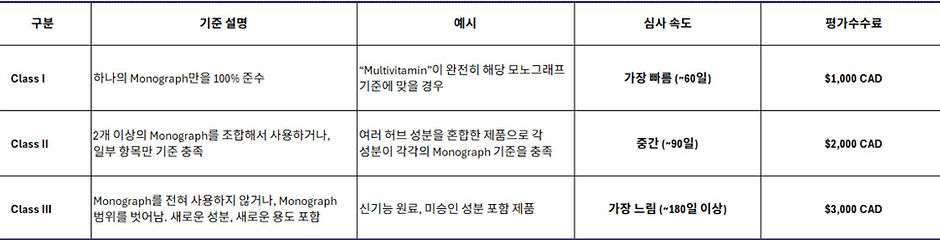
캐나다 자연 건강 제품(NHP) 성분 정보 Database
캐나다에서 자연 건강 제품(NHP)을 판매하거나 등록하려면, 사용 가능한 의약 성분 및 비의약 성분에 대한 기준을 정확히 이해하는 것이 중요합니다. Health Canada는 공식 데이터베이스를 통해 허용된 성분 목록을 제공하고 있으며, 각 성분의 용도와 제한 사항도 함께 확인할 수 있습니다.
캐나다 자연 건강 제품(NHP) 유통 제품 Database
Licensed Natural Health Products Database (LNHPD)에서는 현재 제품의 시장 유통 상태(market status)를 확인할 수 있습니다. 제품이 현재 “marketed(판매 중)”인지, 또는 “not marketed(판매되지 않음)”인지를 표시하여 현재 캐나다 시장에서 유통유무 확인이 가능합니다.
자주 묻는 질문
Product Labeling Requirements for Cosmetics in Canada
Product Identity: Must allow consumers to clearly understand the nature or intended use of the product.
Net Quantity: Must be displayed in metric units (g or mL), with a space between the number and the unit (e.g., “100 mL”).
Ingredient List: Must follow INCI (International Nomenclature of Cosmetic Ingredients) standards.
Ingredients present at 1% or more must be listed in descending order of concentration.
Ingredients present at less than 1% may be listed in any order.
Manufacturer: Include manufacturer information (a Korean address is acceptable).
Importer: Required if the importer is the selling entity — a Canadian address is mandatory.
Distributor: Required if the distributor is the selling entity — a Canadian address is mandatory.
Directions for Use: Instructions for use must be provided in both English and French.
Warnings / Cautions: Any necessary safety or cautionary statements must also be displayed in both English and French.
Many sellers misunderstand the “Responsible Person (RP)” labeling requirement as optional when selling cosmetics in Canada.
However, according to Health Canada regulations, every cosmetic label must include Responsible Person (RP) information.
The Responsible Person (RP) refers to the legal entity in Canada responsible for ensuring the product’s safety and regulatory compliance.
Under Health Canada’s Cosmetic Regulations, all cosmetic labels must display the company name, a contactable Canadian address, and contact information where consumers can reach the RP in case of inquiries, adverse reactions, or safety concerns.
It is also recommended that this information appear in both English and French.This requirement ensures that product recalls, adverse event reports, and regulatory reviews can be handled quickly and efficiently.
Products without RP information are considered non-compliant and may be held at customs or prohibited from sale in Canada.
Trufulfillment provides RP services for Korean cosmetic brands that do not have a Canadian legal entity.
👉 Inquiries for RP Service: support@trufulfillment.ca
All cosmetics sold in Canada must have bilingual labeling in both English and French, and the following mandatory information must be clearly displayed on the product label:
Product Identity (제품명)
Net Quantity (순용량)
Directions for Use (사용법)
Warning or Caution Statements (경고문구)
Exception:If the product’s use is obvious to consumers even when labeled only in English — for example, a lipstick — then English-only labeling may be acceptable.
The import duty rate for Korean-made cosmetics classified under HS Code 3304.99 is 0% in Canada.This can be verified in the Canada Border Services Agency (CBSA) tariff schedule, where the rightmost column labeled “KRT (Korea Tariff)” indicates the 0% duty rate applied under the Canada–Korea Free Trade Agreement (CKFTA).
Source:2024 Canadian Customs Tariff (CBSA): Link
Health Canada requires that all cosmetics sold in Canada be registered through the Cosmetic Notification Form (CNF) within 10 days from the first date of sale in Canada.
The CNF registration process is typically completed within 7 days, and upon submission, applicants receive a Submission Number and a Case Number.The issuance of the final Cosmetic Number (CN) may take anywhere from 1 week to up to 8 weeks, depending on the volume of pending applications at Health Canada.
However, once the CNF submission is accepted and both the Submission Number and Case Number have been issued, the product can be legally sold in Canada even before the final Cosmetic Number (CN) is granted.
According to the amended regulations effective October 2024, all cosmetic products manufactured outside of Canada must include a Canadian contact address where consumers can reach the responsible party.
The Responsible Person (RP) — that is, the importer or distributor responsible for the sale and distribution of the product within Canada — must be clearly identified on the label with one of the following designations, followed by a Canadian address and contact information:
Imported by
Imported for
Distributor
While the physical Canadian address is mandatory, the contact information may be provided in digital form, such as a website URL or email address.
Sunscreen products sold in Canada are classified into two main categories — inorganic (mineral) filters and organic (chemical) filters — each requiring a different type of registration:
1) Inorganic Sunscreens → Natural Health Product (NHP) Registration Required
Ingredients such as Titanium Dioxide and Zinc Oxide are permitted at concentrations of up to 25%.Products containing these ingredients are classified as Natural Health Products (NHPs) and must undergo review and registration with the NNHPD (Natural and Non-prescription Health Products Directorate) of Health Canada.
2) Organic Sunscreens → Drug Registration Required (DIN)
Organic UV filters such as Avobenzone, Oxybenzone, and Octocrylene must comply with Health Canada’s maximum allowable concentration limits, including:
Avobenzone: up to 3%
Oxybenzone: up to 6%
Products containing these ingredients are classified as Drugs and must obtain a Drug Identification Number (DIN) before being marketed or sold in Canada.
Expressions That Must Not Appear on Sunscreen Labels or Advertisements
“Sunblock”, “sun shield”, or any wording implying complete UV protection or total sun blockage
Claims suggesting enhanced or multiplied UV protection, such as “Protects X times better from UV rays”
Statements implying the product is intended to prevent sunburn in sun-sensitive individuals or those with fair skin
Phrases indicating the product is for skin that must not be exposed to sunlight
Any claim that the product induces, prolongs, or enhances tanning
Statements suggesting users can stay longer in the sun when using the product
The terms “Waterproof” or “Sweat proof”
Claims that the product can repair or reverse skin damage
Statements referring to it as a product for infants’ scalp
Use of a “+” sign next to SPF values (e.g., SPF 30+) — except SPF 50+, which is permitted
“Long-lasting” or “sustained action” claims (e.g., lasting more than 2 hours or over 80 minutes in water)
Combination products containing insect repellent (dual-purpose UV protection + repellent)
Any indication that the product prevents skin cancer
Claims that the product prevents skin damage such as dark spots, wrinkles, or pigmentation
Statements implying that using this product alone can prevent or reduce long-term skin damage or cancer
Claims of blocking UVC or other non-UVA/UVB rays
Claims that the product is “photostable”
Claims that the product can be applied directly to wet or sweaty skin
The “Cosmetic Ingredient Hotlist” is a list maintained by Health Canada that identifies substances that are prohibited or restricted in cosmetic products. This list plays a vital role in protecting consumer health and safety.
Cosmetic manufacturers are required to carefully review and comply with the Hotlist when formulating products. The use of prohibited ingredients can result in skin allergies or serious health effects, making strict adherence to this list essential during product development and manufacturing.
For example, Benzethonium Chloride is an ingredient with strong antiseptic properties but can irritate the skin or mucous membranes. Therefore, its concentration is restricted as follows:
Rinse-off products: must contain no more than 0.3%
Leave-on products: must contain no more than 0.2%
Products containing restricted ingredients must strictly observe the permitted concentration limits.
Consumers are also encouraged to consult the Hotlist when choosing cosmetics to ensure product safety. Reading and understanding ingredient labels helps individuals make informed and health-conscious choices about the cosmetic products they use.
자주 묻는 질문
Product Labeling Requirements for Cosmetics in Canada
Product Identity: Must allow consumers to clearly understand the nature or intended use of the product.
Net Quantity: Must be displayed in metric units (g or mL), with a space between the number and the unit (e.g., “100 mL”).
Ingredient List: Must follow INCI (International Nomenclature of Cosmetic Ingredients) standards.
Ingredients present at 1% or more must be listed in descending order of concentration.
Ingredients present at less than 1% may be listed in any order.
Manufacturer: Include manufacturer information (a Korean address is acceptable).
Importer: Required if the importer is the selling entity — a Canadian address is mandatory.
Distributor: Required if the distributor is the selling entity — a Canadian address is mandatory.
Directions for Use: Instructions for use must be provided in both English and French.
Warnings / Cautions: Any necessary safety or cautionary statements must also be displayed in both English and French.
Many sellers misunderstand the “Responsible Person (RP)” labeling requirement as optional when selling cosmetics in Canada.
However, according to Health Canada regulations, every cosmetic label must include Responsible Person (RP) information.
The Responsible Person (RP) refers to the legal entity in Canada responsible for ensuring the product’s safety and regulatory compliance.
Under Health Canada’s Cosmetic Regulations, all cosmetic labels must display the company name, a contactable Canadian address, and contact information where consumers can reach the RP in case of inquiries, adverse reactions, or safety concerns.
It is also recommended that this information appear in both English and French.This requirement ensures that product recalls, adverse event reports, and regulatory reviews can be handled quickly and efficiently.
Products without RP information are considered non-compliant and may be held at customs or prohibited from sale in Canada.
Trufulfillment provides RP services for Korean cosmetic brands that do not have a Canadian legal entity.
👉 Inquiries for RP Service: support@trufulfillment.ca
All cosmetics sold in Canada must have bilingual labeling in both English and French, and the following mandatory information must be clearly displayed on the product label:
Product Identity (제품명)
Net Quantity (순용량)
Directions for Use (사용법)
Warning or Caution Statements (경고문구)
Exception:If the product’s use is obvious to consumers even when labeled only in English — for example, a lipstick — then English-only labeling may be acceptable.
The import duty rate for Korean-made cosmetics classified under HS Code 3304.99 is 0% in Canada.This can be verified in the Canada Border Services Agency (CBSA) tariff schedule, where the rightmost column labeled “KRT (Korea Tariff)” indicates the 0% duty rate applied under the Canada–Korea Free Trade Agreement (CKFTA).
Source:2024 Canadian Customs Tariff (CBSA): Link
Health Canada requires that all cosmetics sold in Canada be registered through the Cosmetic Notification Form (CNF) within 10 days from the first date of sale in Canada.
The CNF registration process is typically completed within 7 days, and upon submission, applicants receive a Submission Number and a Case Number.The issuance of the final Cosmetic Number (CN) may take anywhere from 1 week to up to 8 weeks, depending on the volume of pending applications at Health Canada.
However, once the CNF submission is accepted and both the Submission Number and Case Number have been issued, the product can be legally sold in Canada even before the final Cosmetic Number (CN) is granted.
According to the amended regulations effective October 2024, all cosmetic products manufactured outside of Canada must include a Canadian contact address where consumers can reach the responsible party.
The Responsible Person (RP) — that is, the importer or distributor responsible for the sale and distribution of the product within Canada — must be clearly identified on the label with one of the following designations, followed by a Canadian address and contact information:
Imported by
Imported for
Distributor
While the physical Canadian address is mandatory, the contact information may be provided in digital form, such as a website URL or email address.
Sunscreen products sold in Canada are classified into two main categories — inorganic (mineral) filters and organic (chemical) filters — each requiring a different type of registration:
1) Inorganic Sunscreens → Natural Health Product (NHP) Registration Required
Ingredients such as Titanium Dioxide and Zinc Oxide are permitted at concentrations of up to 25%.Products containing these ingredients are classified as Natural Health Products (NHPs) and must undergo review and registration with the NNHPD (Natural and Non-prescription Health Products Directorate) of Health Canada.
2) Organic Sunscreens → Drug Registration Required (DIN)
Organic UV filters such as Avobenzone, Oxybenzone, and Octocrylene must comply with Health Canada’s maximum allowable concentration limits, including:
Avobenzone: up to 3%
Oxybenzone: up to 6%
Products containing these ingredients are classified as Drugs and must obtain a Drug Identification Number (DIN) before being marketed or sold in Canada.
Expressions That Must Not Appear on Sunscreen Labels or Advertisements
“Sunblock”, “sun shield”, or any wording implying complete UV protection or total sun blockage
Claims suggesting enhanced or multiplied UV protection, such as “Protects X times better from UV rays”
Statements implying the product is intended to prevent sunburn in sun-sensitive individuals or those with fair skin
Phrases indicating the product is for skin that must not be exposed to sunlight
Any claim that the product induces, prolongs, or enhances tanning
Statements suggesting users can stay longer in the sun when using the product
The terms “Waterproof” or “Sweat proof”
Claims that the product can repair or reverse skin damage
Statements referring to it as a product for infants’ scalp
Use of a “+” sign next to SPF values (e.g., SPF 30+) — except SPF 50+, which is permitted
“Long-lasting” or “sustained action” claims (e.g., lasting more than 2 hours or over 80 minutes in water)
Combination products containing insect repellent (dual-purpose UV protection + repellent)
Any indication that the product prevents skin cancer
Claims that the product prevents skin damage such as dark spots, wrinkles, or pigmentation
Statements implying that using this product alone can prevent or reduce long-term skin damage or cancer
Claims of blocking UVC or other non-UVA/UVB rays
Claims that the product is “photostable”
Claims that the product can be applied directly to wet or sweaty skin
The “Cosmetic Ingredient Hotlist” is a list maintained by Health Canada that identifies substances that are prohibited or restricted in cosmetic products. This list plays a vital role in protecting consumer health and safety.
Cosmetic manufacturers are required to carefully review and comply with the Hotlist when formulating products. The use of prohibited ingredients can result in skin allergies or serious health effects, making strict adherence to this list essential during product development and manufacturing.
For example, Benzethonium Chloride is an ingredient with strong antiseptic properties but can irritate the skin or mucous membranes. Therefore, its concentration is restricted as follows:
Rinse-off products: must contain no more than 0.3%
Leave-on products: must contain no more than 0.2%
Products containing restricted ingredients must strictly observe the permitted concentration limits.
Consumers are also encouraged to consult the Hotlist when choosing cosmetics to ensure product safety. Reading and understanding ingredient labels helps individuals make informed and health-conscious choices about the cosmetic products they use.
Blog


Lunar New Year 2026 Logistics Strategy


A Comparison and Selection Guide to the Most Efficient Shipping Methods from Korea to Amazon FBA in Canada


